
Why You Forget 90% of New English Words — and How to Make Them Stick
The forgetting curve isn't your fault. Here's how spaced repetition and mnemonic images push English vocabulary into long-term memory.
If you studied 50 new English words on Monday, by Sunday you'll remember about 5 of them.
Not because you're lazy. Not because you're "bad at languages." Because your brain is doing exactly what 200,000 years of evolution designed it to do: dump information it doesn't think you need.
A German psychologist named Hermann Ebbinghaus figured this out in 1885. He sat alone in a room for years, memorizing nonsense syllables and testing himself at intervals. What he discovered is now called the forgetting curve — and it's brutal:
20 minutes after learning: you've already lost 40%
24 hours later: down to ~30%
One week later: about 10% remains
This is the default. This is what happens when you "study" a word once and move on. Your brain is not a hard drive. It's a bouncer who throws out anything that doesn't keep showing up at the door.
The good news: psychologists have spent the last forty years figuring out exactly what makes the bouncer let a word stay. Two techniques stand out, and the research isn't even close. When you stack them, retention jumps from ~12% to ~95%.
Here's how they work — and why almost no learning app combines both.
Technique 1: Spaced Repetition (the "when" problem)
Imagine you meet someone at a party. You hear their name once. Three days later you bump into them at a coffee shop — and you blank. Embarrassing.
Now imagine instead: you hear their name at the party, again the next morning when a friend mentions them, again two days later in a group chat, again a week later. By then, you'll never forget that name.
That's spaced repetition. Same input — but the spacing changes everything.
The technique was formalized in the 1970s by Sebastian Leitner and refined into the SM-2 algorithm by Piotr Woźniak. The idea: review a word right before you would have forgotten it. Each successful recall pushes the next review further out — 1 day, 3 days, 7 days, 14 days, 30 days. The word climbs from short-term memory into long-term storage.
A 2016 paper from Duolingo's research team (Settles & Meeder, ACL) showed that students using spaced repetition retained vocabulary 2-3× longer than students who studied the same words massed together. A meta-analysis by Sean Kang (2016) covering 250+ studies confirmed the effect across virtually every learning domain tested.
This is the "when" of memory. But timing alone isn't enough.
Technique 2: Mnemonic Images (the "how" problem)
Quick test. We'll give you two words. Try to remember them for 30 seconds:
serendipity — finding something good by accident
ephemeral — lasting for a short time only
Now close your eyes for a moment.
…
Did you "see" anything? Most people don't. They just re-read the definition silently in their head.
Now try this:
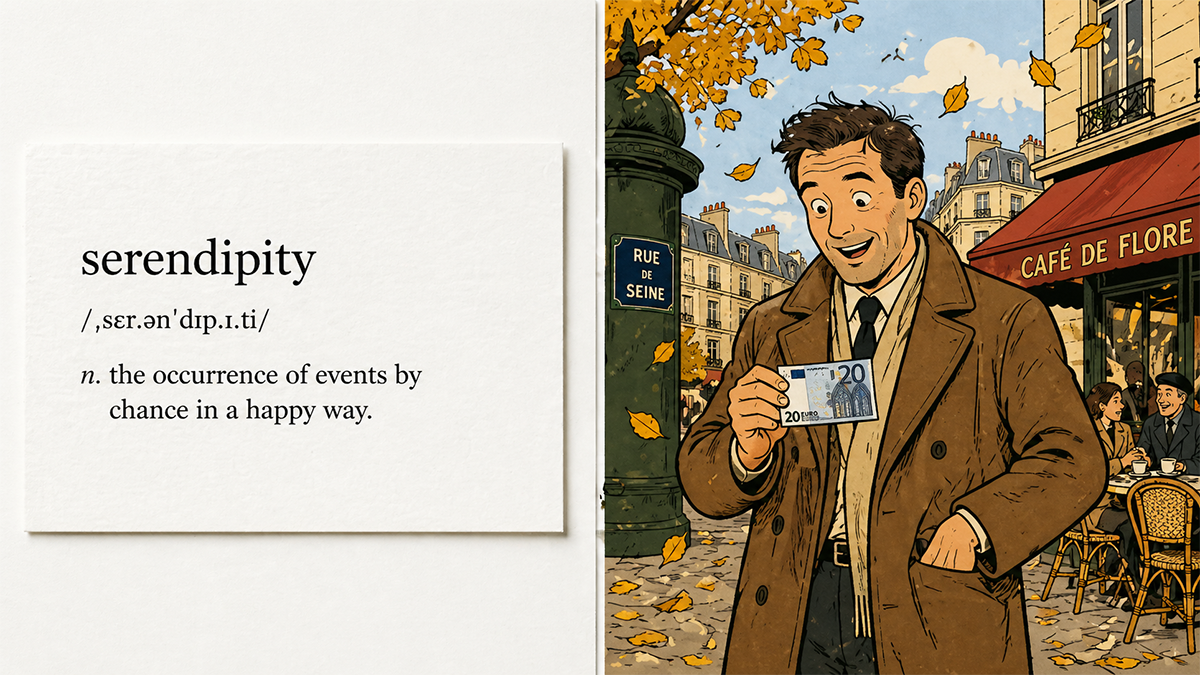
serendipity — picture a man searching his coat pocket for keys and pulling out a forgotten €20 note instead, smiling
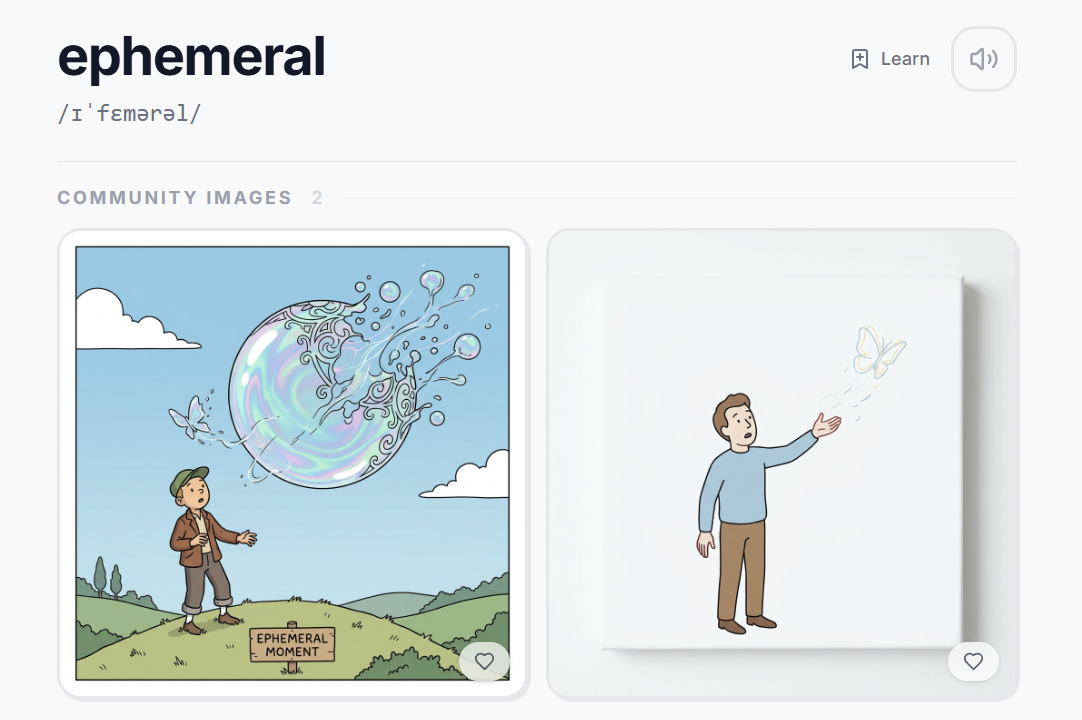
ephemeral — picture a soap bubble drifting across a sunlit kitchen, pop, gone
Tell us honestly: which version are you going to remember tomorrow?
This is dual coding theory, first proposed by Allan Paivio in the 1970s and validated in hundreds of experiments since. Your brain stores verbal and visual information in two separate systems. When a concept is encoded in both, you have two retrieval paths instead of one. Forgetting one doesn't mean losing the word.
Richard Mayer's Cambridge Handbook of Multimedia Learning (2021) summarizes 500+ experiments on this. The headline finding: learners who pair words with images outperform text-only learners by 40-89% depending on the task. A 2015 study by Bui and McDaniel in Memory & Cognition found the effect is even stronger when the image is bizarre or personally meaningful — the weirder, the stickier.
This is why you remember the plot of every movie you've watched but can't recall what you read in your textbook last week. Your brain was built for images.
Why almost no app uses both
Anki uses spaced repetition. Quizlet uses spaced repetition. Duolingo uses spaced repetition.
But the cards? They're text. A word and its translation. Maybe a stock photo if you're lucky.
You're solving the when problem perfectly while ignoring the how problem completely.
The reason is practical: making a custom mnemonic image for every word in your deck used to take hours per word. You'd need to be both a learner and an illustrator. Almost nobody did it, even though every memory champion will tell you it's the single most powerful technique in their toolkit.
That changed about eighteen months ago, when AI image models got good enough to render specific scenes in a consistent style in under five seconds.
That's the gap LingoSnack was built to close — pairing the SRS scheduler every other app already has with a custom AI image for every word you save.
The third trick nobody talks about: explain it like a friend
Here's something we noticed when we started building a vocabulary tool seriously: dictionary definitions are written for people who already know the word.
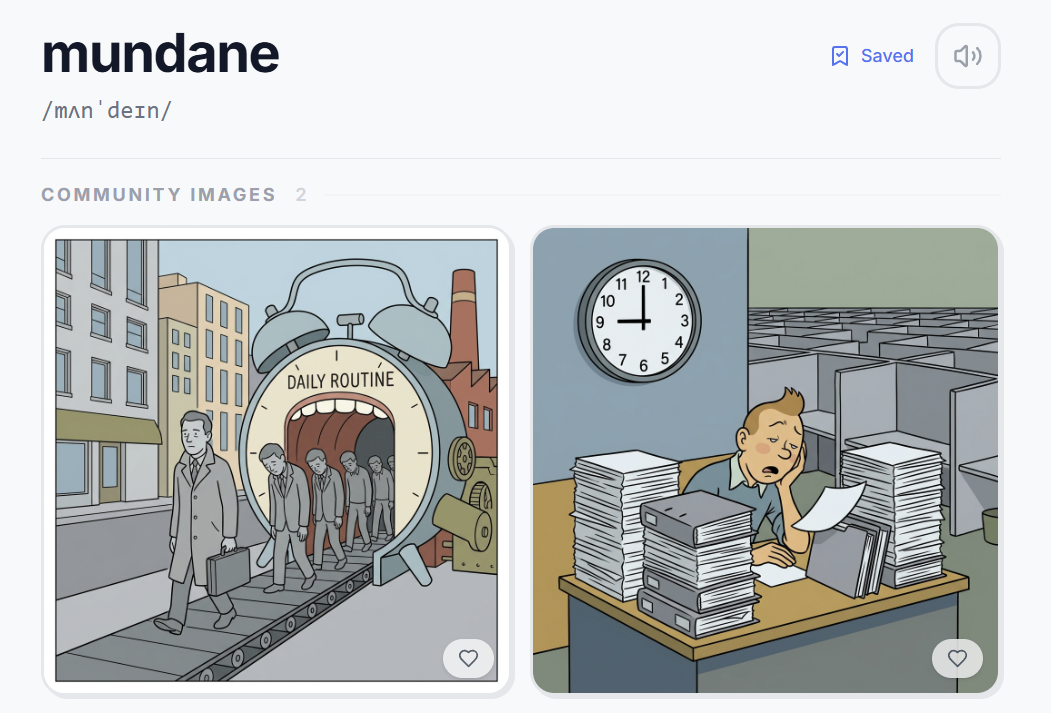
mundane (adj.) — lacking interest or excitement; dull.
Technically correct. Practically useless. Your brain reads "lacking interest or excitement" and stores nothing, because nothing happened. There's no scene, no feeling, no friend telling you a story.
Now read this version, written the way an Italian friend would explain it to you over coffee:
Sai quella mattina in cui ti svegli, ti lavi i denti, fai il caffè, vai al lavoro, torni a casa, e quando arriva sera non riesci a ricordare niente di particolare? Ecco, è quello. "Mundane" è la vita in modalità automatica.
Even if you don't speak Italian, you can feel the difference. The friend version paints. The dictionary version labels.
This turns out to matter a lot. There's a 1972 study by Craik and Lockhart on "levels of processing" that found memory depends less on how often you see a word and more on how deeply you process it. A casual, emotional explanation forces deep processing. A dictionary definition lets you skim past it.
Here are the same word-card "friend explanations" in seven languages:
🇪🇸 Spanish — serendipity
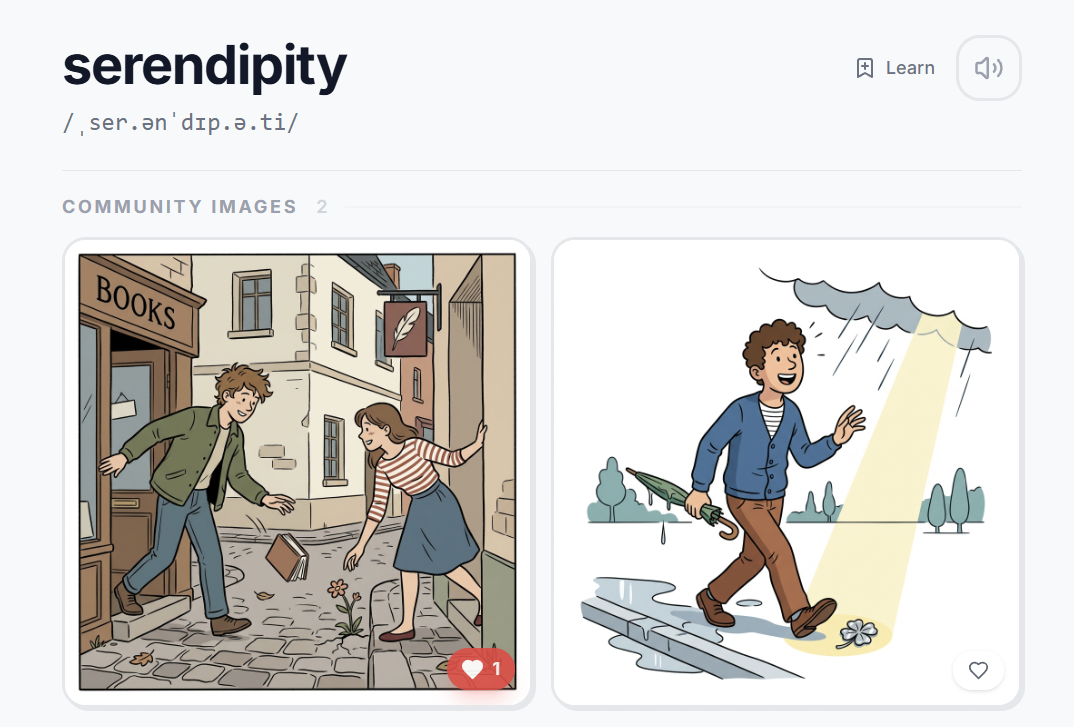
Es esa cosa hermosa que pasa cuando estás buscando una cosa y, ¡pum!, encuentras algo aún mejor que ni siquiera sabías que querías. Como cuando vas a buscar tus llaves y encuentras 20€ en el bolsillo de un abrigo viejo.
🇵🇹 Portuguese — procrastination
Sabe quando você tem um trabalho importante para entregar amanhã e de repente sente uma vontade ENORME de organizar a gaveta de meias? Pois é, isso aí. É deixar para depois o que precisa ser feito agora, geralmente fazendo coisas que normalmente você acharia chatas.
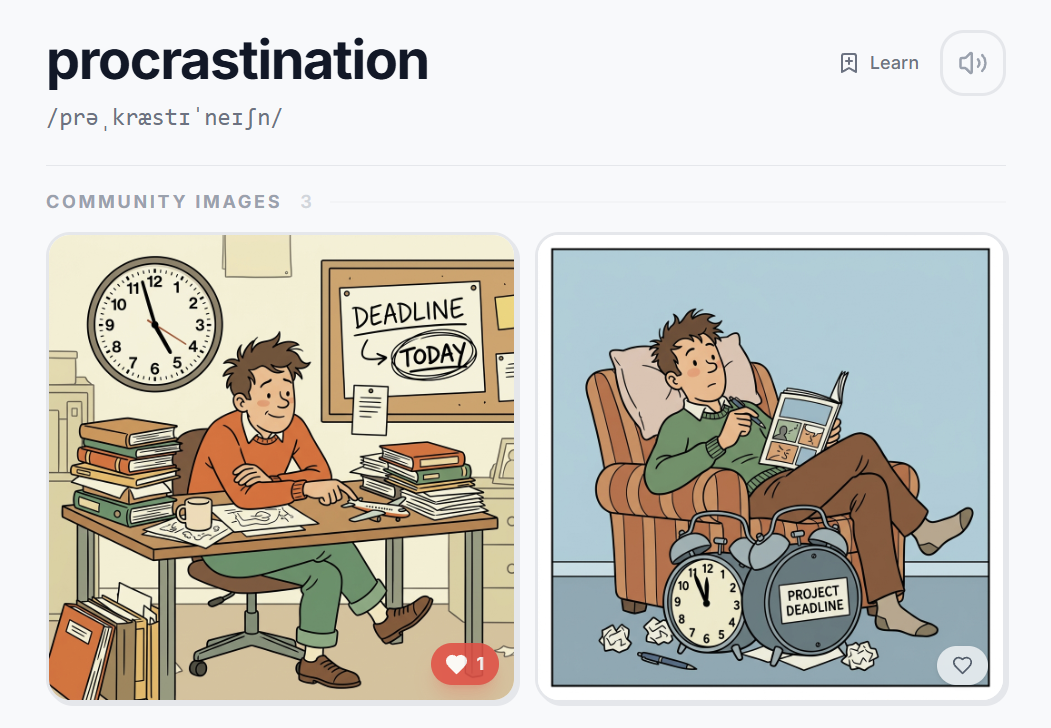
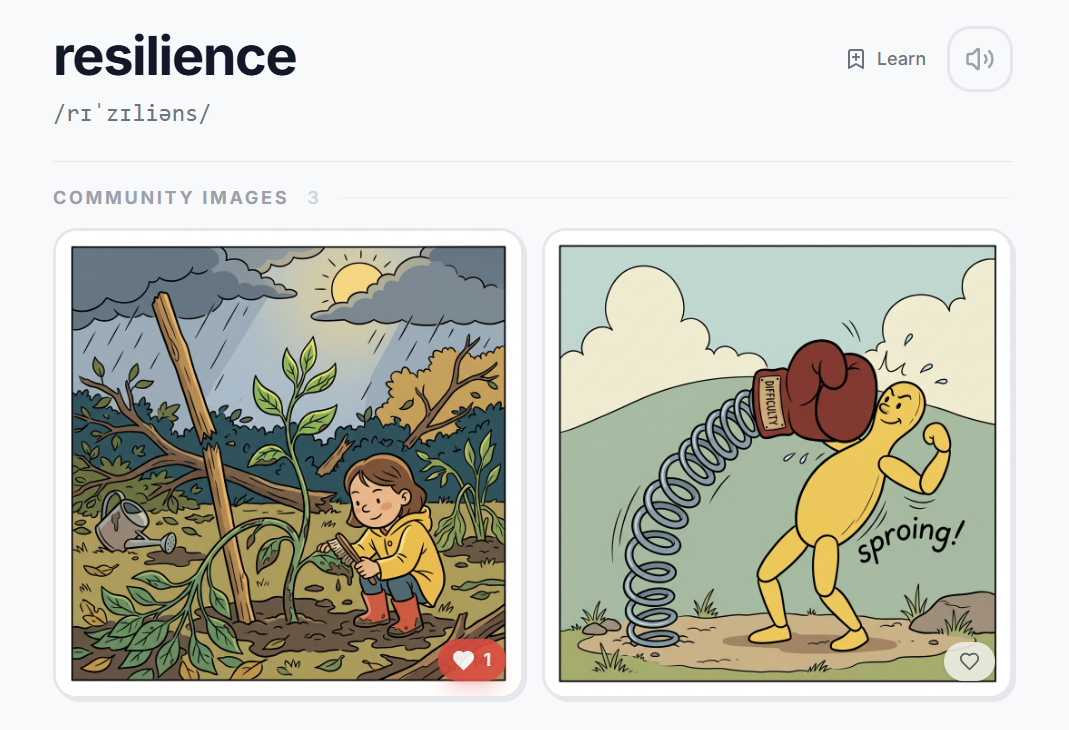
🇫🇷 French — resilience
C'est cette capacité un peu magique de te relever après une grosse claque dans la vie. Imagine un roseau dans la tempête — il plie, il plie, mais il ne casse pas. Ça, c'est la résilience.
🇩🇪 German — ephemeral
Stell dir eine Seifenblase vor — wunderschön, schwebt einen Moment durch die Luft, und plopp, weg. Genau das ist "ephemeral". Etwas Schönes, das nur kurz da ist und dann verschwindet.
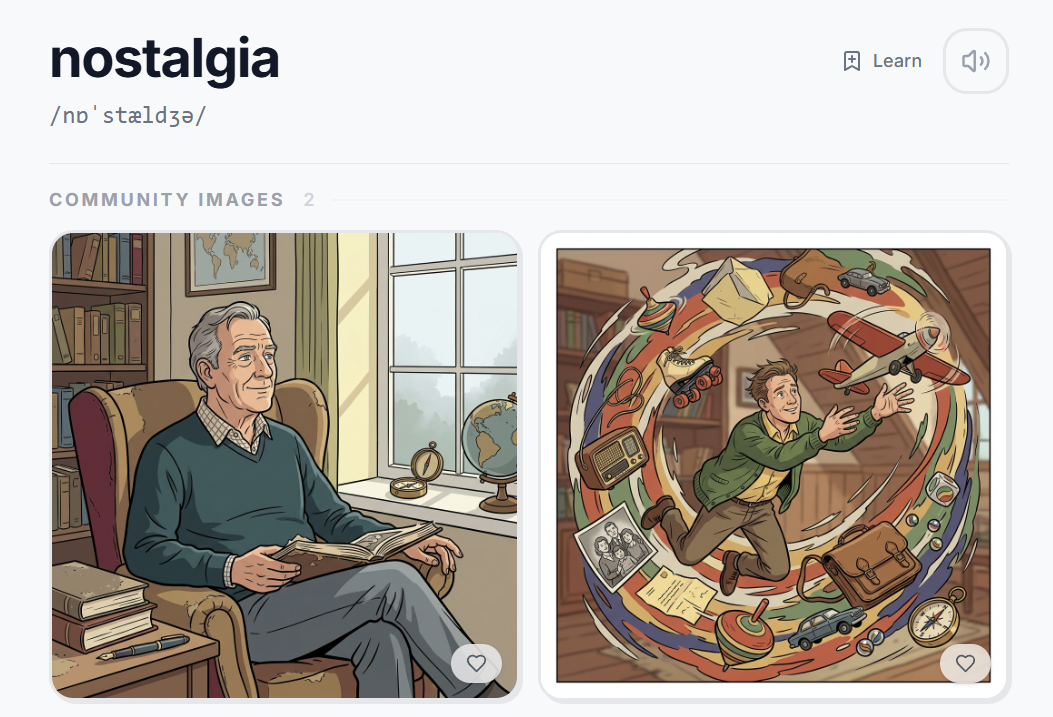
🇯🇵 Japanese — nostalgia
「懐かしい」って気持ちに似てるんだけど、もうちょっと甘くて、ちょっと切ない感じ。昔のアルバムを開いた時の、あの「あー、あの頃は良かったな」って胸がきゅっとなる瞬間。
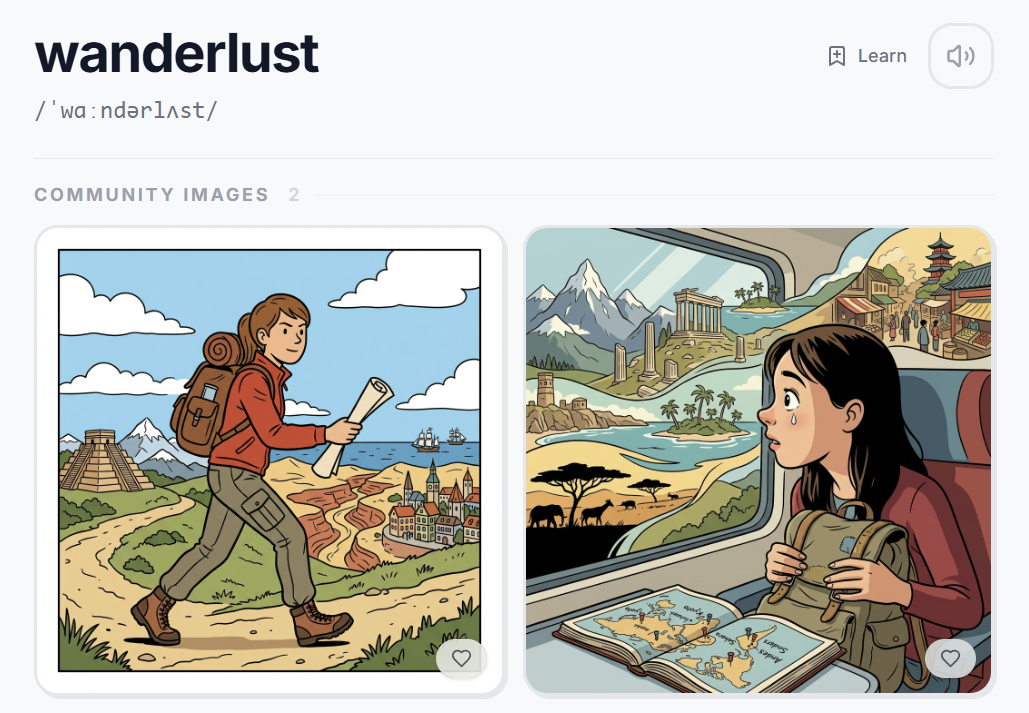
🇷🇺 Russian — wanderlust
Это когда сидишь дома, листаешь чьи-то фотки из Лиссабона, и вдруг внутри что-то щёлкает — хочется бросить всё, схватить рюкзак и уехать куда угодно. Не просто хотеть в отпуск, а тосковать по дорогам.
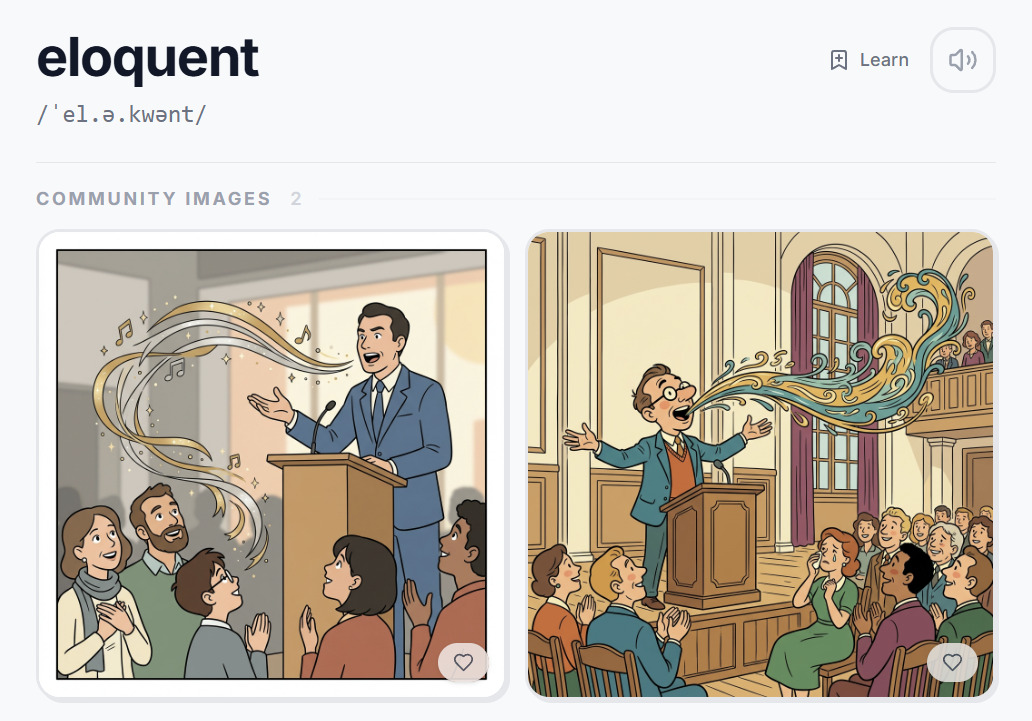
🇹🇷 Turkish — eloquent
Hani bir insan ağzını açıyor ve odadaki herkes susup onu dinliyor ya? Karmaşık şeyleri kolay anlatabilen, doğru anda doğru kelimeyi bulan tipler vardır. İşte o tip insanlar "eloquent"tır.
These aren't hand-written — LingoSnack generates the friend-style explanation in your native language automatically when you look up a word.
Notice what's happening across all seven examples. None of them say "lacking" or "having the quality of." They give you a scene — a wallet, a bubble, a Lisbon photo, a quiet listener. Your brain gets a hook to hang the word on.
This is the third leg of the system. You don't just need spacing (when) and an image (how). You need a meaning that lands — something your brain wants to hold onto.
Putting it together
Here's the full stack:
Look up a word — get a casual, friend-style explanation in your native language (so the meaning lands deep, not skim-deep)
See it as an image — a custom mnemonic illustration burns the word into visual memory
Review on schedule — spaced repetition surfaces the word right before you'd forget it, ratcheting it into long-term storage
In LingoSnack the whole loop — search, generated image, friend-explanation, save to study list — happens in one screen.
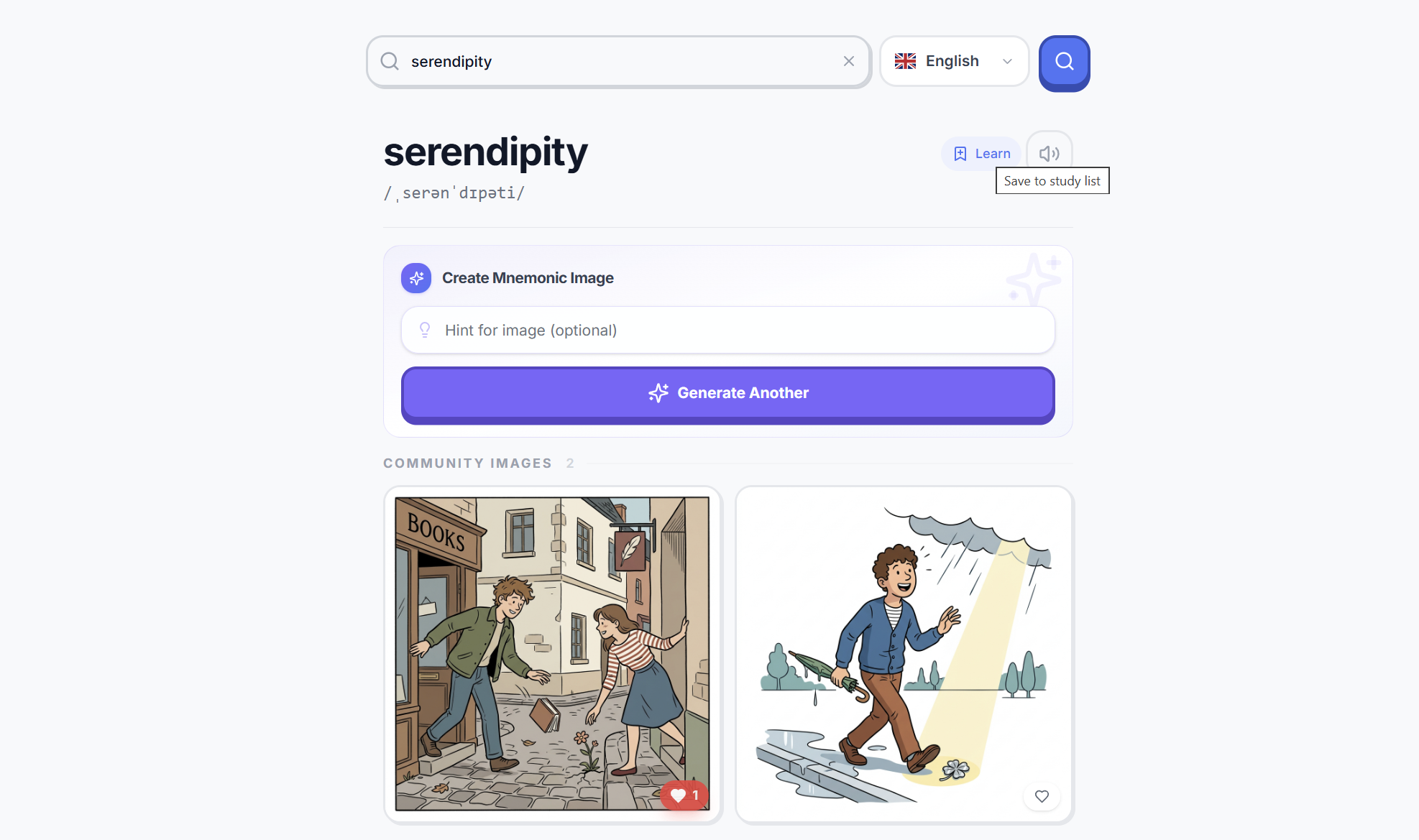
Each piece on its own helps a little. Stacked, they're the difference between forgetting 88% of what you learn and remembering 95%.
What this looks like in practice
We've been running this stack ourselves for the last few months while building LingoSnack — an app we made specifically to combine all three techniques in one workflow. It's free to try, no credit card. We're not going to pretend it's the only way; you can absolutely build this stack manually with Anki + a notebook full of doodles, and people did exactly that for decades.
But if you want it to actually happen in your life — not as a side project that lasts three weeks before the friction wins — having the friend-explanation, the AI image, and the SRS scheduler in one place removes every excuse.
The forgetting curve is going to keep doing its thing whether you fight it or not. Might as well fight it with the right tools.
If you're staring down an exam — IELTS, TOEFL, Cambridge, GRE, whatever's coming — this is the stack that gets vocabulary into long-term memory instead of cramming it into next week's panic. Follow for more on how memory research applies to studying that actually sticks.