
The Best Way to Learn English Vocabulary in 2026 (After Testing 12 Methods)
Spaced repetition handles when you review. Mnemonic images handle how the word sticks. Here's the honest ranking of every major method — and the 2026 stack that takes retention from ~12% to ~95%.

The direct answer: The best way to learn English vocabulary in 2026 is to combine an SRS app that generates a custom mnemonic image for each word with daily comprehensible input (English video or podcasts at your level), plus one weekly conversation session. Apps alone build a passive vocabulary you can't recall in conversation. Input alone leaves words half-known. Stack them, and the published cognitive-science evidence suggests retention climbs from roughly 12% to roughly 95% after thirty days.
Quick verdict — 12 methods ranked for retention
The ranking below scores each method on long-term vocabulary retention after 30 days, not on initial learning fun. Full reasoning per method comes after.
AI mnemonic image SRS (LingoSnack; custom Anki decks with images) — Best overall. Free to start.
Anki + manual image cards — DIY power-user pick. Free, very powerful, hideous UI.
Comprehensible input (YouTube, podcasts, graded readers) — Best supplement. Free. Not a complete stack alone.
Memrise — Pretty SRS with native-speaker video clips. ~$8/mo. Generic image library.
1-on-1 tutoring (italki, Preply) — Best for output and accountability. $10-30/hour.
AI chat tutors (custom ChatGPT/Claude/Gemini setups) — Best free conversation. $0-20/mo.
Shows with dual subtitles (Language Reactor, Mate Translate) — Best entertainment-as-input. Free.
Reading novels and graded readers — Excellent for context, slow for breadth. Free or cheap.
Quizlet — Student-friendly flashcards. Free with ads. Algorithm is outdated by 2026 standards.
Babbel — Structured beginner courses. ~$14/mo. Not built for retention past A2.
Duolingo — Best habit-builder. Free with ads. Genuinely weak for productive vocabulary.
Rosetta Stone — Image-matching software. ~$12/mo. Effectively obsolete in 2026.
The full breakdown is below. First, two things worth knowing about why this list looks different from one you'd have written in 2020.
What changed between 2020 and 2026
Three concrete shifts, all worth ten minutes of your attention:
1. FSRS replaced SM-2. Until 2023, every spaced-repetition app — including Anki — used the SM-2 algorithm designed by Piotr Woźniak in 1985. In 2024, Anki adopted FSRS (Free Spaced Repetition Scheduler), built by Jarrett Ye and trained on hundreds of millions of real review logs. FSRS predicts your personal forgetting curve per card and reduces review load by roughly 20-30% for the same retention target. If your app still defaults to SM-2 in 2026, it is one full generation behind.
2. AI image generation became fast, cheap, and consistent. In 2020, building a custom mnemonic image for every new word was a memory-champion technique. You hired an illustrator or drew matchstick figures. In 2026, modern image models render a custom illustration of any word, in a consistent style, in under five seconds for fractions of a cent. This collapses dual-coding theory — the single most-powerful retention technique in cognitive science — from "impossible at scale" to "default for every new word."
3. AI dictionaries deliver explanations, not definitions. Traditional dictionaries write definitions for people who already know the word. AI dictionaries write casual explanations in your native language, the way a friend would explain a word over coffee. This activates what cognitive psychology calls levels of processing (Craik & Lockhart, 1972): memory depth depends on depth of processing, not on frequency of exposure.
Together, these three shifts change which methods are best. They also explain why the 2026 best stack centers on a technique that was effectively unavailable in 2020.
The 4 things that make English vocabulary stick
Before the rankings, the framework. Cognitive psychology has converged on four ingredients for durable vocabulary memory. Every method below succeeds or fails on how many it covers.
1. Spacing — the when. You forget a new word on a predictable curve unless you re-encounter it just before forgetting kicks in. Each successful retrieval pushes the next review further out: 1 day, 3 days, 7 days, 14 days, 30 days. This is the entire purpose of spaced repetition. A meta-analysis of 250+ studies by Sean Kang (2016) confirms the effect across virtually every learning domain. Settles & Meeder (Duolingo research team, ACL 2016) showed students using spaced repetition retained vocabulary 2-3× longer than students who massed the same words in a single session.
2. Encoding depth — the how. Allan Paivio's dual coding theory (1971) holds that verbal and visual information live in separate brain systems. A word encoded in both has two retrieval paths instead of one. Richard Mayer's Cambridge Handbook of Multimedia Learning (2021) summarizes 500+ experiments: learners who pair words with images outperform text-only learners by 40-89% depending on the task. Bui & McDaniel (2015, Memory & Cognition) found the effect strengthens when the image is bizarre or personally meaningful — the weirder, the stickier.
3. Retrieval practice — recall, not recognition. Re-reading a word and its meaning does almost nothing for retention. Generating the meaning from memory — even being wrong sometimes — does almost everything. Karpicke & Roediger (2008, Science) showed retrieval practice produces 2-3× the long-term retention of equal-time re-reading. This is why fill-in-the-blank flashcards beat multiple-choice ones.
4. Comprehensible exposure — the where you meet the word. Stephen Krashen's input hypothesis (1985) argues you acquire vocabulary fastest when you meet words inside context that's just slightly above your level — what he called "i+1." Corpus studies suggest a word typically needs 6-10 meaningful exposures to move from passive recognition to active production. Apps build the passive vocabulary; input turns it active.
A method that nails all four is rare. The ranking below is essentially "how many of these four does this method cover, and how well."
1. AI mnemonic image SRS — best overall
Best for: Anyone serious about long-term retention.
Not for: Pronunciation drilling, grammar, listening comprehension.
Cost: Free tiers exist; paid tiers $5-30/month.
Covers: spacing ✓ encoding ✓ retrieval ✓ exposure ✗
This is the only category that combines AI-generated custom images, casual native-language explanations, and modern spaced repetition scheduling in a single review flow. You search a word, see a friend-style explanation in your language, see a custom illustration of the meaning in a unified, memorable art style, hear native audio, save it, and the scheduler surfaces the word again right before you'd forget it.
LingoSnack is built specifically around this stack. The retention curve goes from ~12% after 30 days (rote re-reading) to ~95% (SRS + mnemonic images), based on the Settles & Meeder and Mayer numbers above stacked on the same vocabulary.
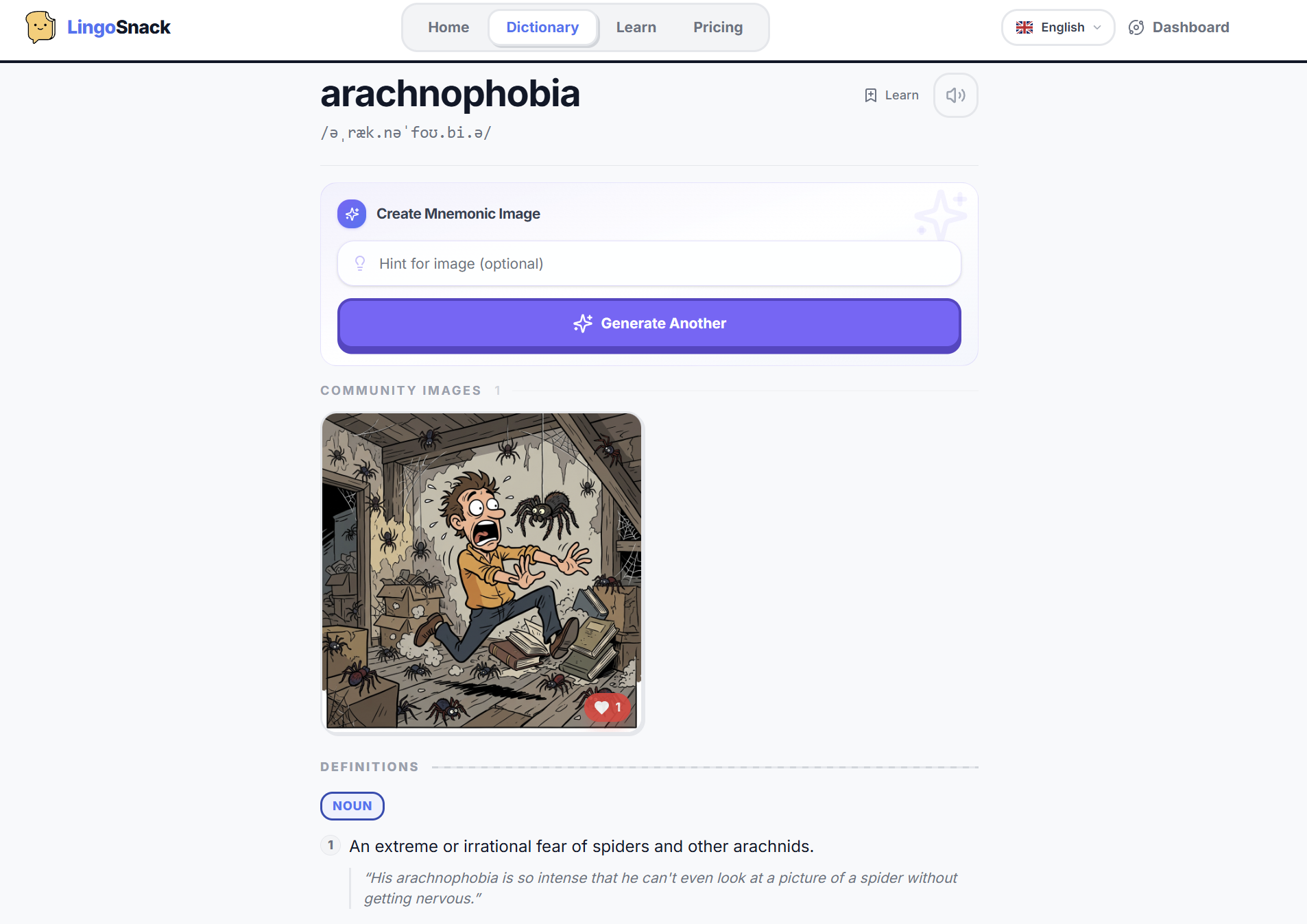
Verdict: the highest-coverage method available in 2026. Pair with comprehensible input below for the full stack.
2. Anki + manual image cards — DIY power pick
Best for: Budget-conscious learners who enjoy setup work.
Not for: Beginners overwhelmed by configuration.
Cost: Free on desktop and Android; $25 once on iOS.
Covers: spacing ✓ encoding ✓ (if you add images yourself) retrieval ✓ exposure ✗
Anki adopted FSRS in 2024 and remains the most powerful pure SRS available. The catch: it ships as a blank tool. You build your own decks or download community ones. Adding mnemonic images means generating or finding them yourself, then pasting into each card — meaningful friction that breaks the habit for most learners.
Verdict: technically excellent, practically attritional. Best for the 5-10% of learners who genuinely enjoy tooling. Everyone else burns out within two months.
3. Comprehensible input — best supplement
Best for: Turning passive vocabulary into active recall.
Not for: Building vocabulary from zero — too slow.
Cost: Free (YouTube, podcasts, library graded readers).
Covers: spacing ✗ encoding (loose) retrieval (passive) exposure ✓✓
Stephen Krashen's hypothesis, modernized. Find English video or audio that's roughly 80-90% comprehensible to you, and consume daily. For beginners, slow-spoken YouTube channels (Easy English, Comprehensible Input English). For intermediates, podcasts at 0.9× speed. For advanced, TV with English subtitles. Words you've previously SRS'd start jumping out of the dialogue — that's the moment they move from passive to active.
Verdict: essential supplement to any vocabulary system. Bad as a standalone strategy for under-B2 learners because the random encounter rate is too low to build raw breadth.
4. Memrise
Best for: Learners who want native-speaker video clips built in.
Not for: Anyone wanting custom mnemonic images per word.
Cost: Around $8-9/month.
Covers: spacing ✓ encoding (generic stock images) retrieval ✓ exposure (video clips)
Memrise rebuilt itself around short native-speaker video clips around 2022. The SRS engine is decent, the UI is pleasant, and the videos add authentic exposure. The weakness: the images are stock photos and don't give you the dual-coding boost custom mnemonic illustrations do.
Verdict: a fine middle-of-the-road choice. Outclassed on retention by anything with custom mnemonic images.
5. 1-on-1 tutoring (italki, Preply)
Best for: Output, accountability, pronunciation feedback.
Not for: Raw vocabulary volume — too expensive per word.
Cost: $10-30/hour for non-native tutors; $25-60/hour for natives.
Covers: spacing ✗ encoding (situational) retrieval ✓ exposure ✓
The single best tool for forcing yourself to produce English you'd otherwise let stay passive. Tutors won't teach you 30 new words an hour — that isn't what they're for. They will teach you which 30 of the words you already "know" you can actually use under pressure.
Verdict: essential at the intermediate stage. Wasteful as a primary vocabulary-building tool.
6. AI chat tutors (ChatGPT, Claude, Gemini)
Best for: Unlimited cheap conversation practice in 2026.
Not for: Structured curriculum or review scheduling.
Cost: $0-20/month depending on model.
Covers: spacing ✗ encoding (situational) retrieval ✓ exposure ✓
Any frontier chat model can roleplay any scenario, correct your grammar, and explain words at your level. With a one-line system prompt — "You are an English tutor for an upper-intermediate Spanish speaker. Always respond in English, then add corrections in Spanish at the end" — you get an infinitely patient conversation partner.
Verdict: strictly better than no conversation practice. Inferior to human tutors for accountability — you can quit ChatGPT at 11 p.m. with zero social cost.
7. Shows with dual subtitles
Best for: Enjoyable exposure to colloquial register.
Not for: Anyone hoping vocabulary will stick automatically.
Cost: Free with a browser extension (Language Reactor, Mate Translate) on Netflix/YouTube.
Covers: spacing ✗ encoding (audiovisual) retrieval ✗ exposure ✓
Beautiful technology, weak retention. You see "implausible" in subtitles, hover, get the translation, smile, forget it within 24 hours. The encounter rate is high but the encoding depth is shallow — you're recognizing the word, not retrieving it. If you SRS the words you hover, this becomes the second-most-powerful tool on the list.
Verdict: great motivator, weak teacher unless paired with an SRS save-on-hover workflow.
8. Reading novels and graded readers
Best for: Context, register, sentence patterns.
Not for: Absolute beginners — frustration kills the habit.
Cost: Free at libraries; cheap on Kindle.
Covers: spacing ✗ encoding (contextual) retrieval ✗ exposure ✓✓
Graded readers for beginners (Penguin Readers, Oxford Bookworms), then short stories, then novels. Reading is the highest-density exposure method available — you meet 500-1,000 unique words an hour. The retention problem is the same as with shows: low encoding depth without active follow-up.
Verdict: indispensable above B1. Pointless below A2 unless you actively look up and SRS every unknown word.
9. Quizlet
Best for: Quick study before a vocabulary test.
Not for: Long-term retention.
Cost: Free with ads; $36/year for Plus.
Covers: spacing (basic) encoding (text-only) retrieval ✓ exposure ✗
Quizlet popularized digital flashcards in the 2010s but has not seriously updated its scheduling algorithm. In 2026 it lags FSRS-based competitors. The UI is friendly and the community decks are large — useful as a starting point, less useful as a long-term home.
Verdict: fine for cramming, weak for permanent learning.
10. Babbel
Best for: Structured A1-A2 beginners who want a curriculum.
Not for: Retention past intermediate level.
Cost: ~$14/month or $84/year.
Covers: spacing (light) encoding (illustrated) retrieval ✓ exposure ✗
A well-designed course product. Lessons are short, explanations are clear, and the vocabulary is sequenced sensibly for absolute beginners. The problem appears around A2: Babbel teaches you a word, then doesn't bring it back at intervals long enough to matter for permanent retention.
Verdict: a good first three months, then graduate to an SRS.
11. Duolingo
Best for: Building a daily English habit at zero cost.
Not for: Anyone whose primary goal is vocabulary retention.
Cost: Free with ads; ~$7-13/month Super.
Covers: spacing (light) encoding (cartoon) retrieval ✓ exposure ✗
The world's most popular language app. The streak mechanic is genuinely effective at habit formation. The vocabulary curriculum is genuinely weak — translation drills with cartoon characters teach recognition rather than recall, and words cycle slowly. Duolingo's own researchers published Settles & Meeder (2016), the paper that showed SRS dramatically outperforms what their app implements at scale.
Verdict: keep it as your daily English alarm clock. Don't expect it to do the actual teaching.
12. Rosetta Stone
Best for: Nostalgic 2008 immersion fans.
Not for: Anyone in 2026 with $12/month to spend.
Cost: ~$12/month with discounts.
Covers: spacing ✗ encoding (image matching) retrieval ✗ exposure (artificial)
The image-matching format that made Rosetta Stone famous (no translations, just pictures) is genuinely interesting cognitive science. The execution — generic stock photos of scenes — has not been meaningfully updated. Modern AI image generation makes the entire Rosetta Stone product feel like a museum piece.
Verdict: effectively obsolete in 2026.
The 2026 stack that actually works
A single tool covers at most three of the four ingredients. The honest answer is that you need a stack — and the good news is the stack costs roughly $0-30/month and ~45 minutes a day.
Layer 1 — Encoding (10-15 min/day). AI mnemonic image SRS. Search new words, save them, review the ones due today. Handles spacing, encoding depth, and retrieval. LingoSnack out of the box, or Anki + FSRS + your own images.
Layer 2 — Exposure (20-30 min/day). Comprehensible input at your level. Below B1: graded YouTube channels. B1-B2: podcasts at 0.9× speed. B2+: TV with English subtitles, novels, news. Handles comprehensible exposure and reactivates words from Layer 1.
Layer 3 — Output (30 min/week). One paid tutor session or daily AI chat in English. Handles retrieval under pressure — the test that converts passive vocabulary into spoken fluency.
If you do nothing else, do Layer 1 daily and Layer 2 daily. Layer 3 is the multiplier that gets you to native-feeling fluency — but Layer 1 + Layer 2 alone outperforms any single-app strategy by a wide margin.
Five common mistakes that waste years
1. Translating instead of imagining. When you meet a new word, your brain wants to map it to its native-language equivalent. That's a single retrieval path. Instead, pause and picture the word. The image creates the dual encoding that translation skips.
2. Doing flashcards in bulk on weekends. Spaced repetition only works if the spacing is preserved. Six hours on Saturday equals about one hour of effective learning. Twenty minutes a day equals about two hours of effective learning. The math is brutal.
3. Studying word-frequency lists in isolation. "Top 1000 English words" lists look efficient and aren't. Words detached from context don't stick — they need a scene, an emotion, a friend's voice explaining them. Use frequency lists to decide which words to learn, not as your only encoding.
4. Watching shows with native-language subtitles. Your brain reads its own language and ignores the English audio. Switch to English subtitles, or to dual subtitles where English is on top. Both options force the second retrieval path.
5. Adding 50 new words a day. Most learning apps cap daily new cards around 10-20. There's a reason. New cards generate review obligations that compound. At 50/day you'll quit within a month — and your retention curve will end up worse than if you'd added 10/day for a year.
Frequently asked questions
How long does it take to learn English vocabulary in 2026?
Reaching B2 (~4,000 active words) takes most learners 600-1,000 hours of focused practice. With the stack above (~45 min/day), that's two to four years. AI mnemonic images and FSRS scheduling shorten the timeline meaningfully but not magically — the binding constraint is exposure hours, not technology.
How many new English words should I learn per day?
Ten new words per day, reviewed daily, gets you to ~3,600 words in a year — enough for confident B2-level reading and listening. Ten is the limit most learners can sustain without burnout. Twenty is doable for two months, then collapses.
Is Duolingo enough to learn English?
For habit and basic comfort, yes. For productive vocabulary past A2, no. Duolingo's own researchers published the SRS paper (Settles & Meeder, 2016) that explains why their app's design choices favor engagement over retention.
Is Anki still the best in 2026?
Anki with FSRS is the most powerful pure SRS available, but it ships as a blank tool. The retention advantage of AI-generated mnemonic images over plain text cards is large enough that an app providing them out of the box (such as LingoSnack) generally beats Anki for everyone except power users who genuinely enjoy building decks.
Do I really need a tutor?
To move from "I understand English" to "I speak English fluently," yes — or a substitute that forces production. AI chat tutors are a workable replacement at a fraction of the cost, with a tenth of the accountability.
Can I learn English vocabulary with ChatGPT alone in 2026?
You can practice with it, get explanations from it, and roleplay scenarios with it. You can't rely on it to schedule your reviews — ChatGPT doesn't know which word you saw on day 3 and need again on day 7. Pair ChatGPT (output) with an SRS app (scheduling), and you have most of the stack.
What's the difference between SM-2 and FSRS?
SM-2 is the original 1985 scheduling algorithm — a fixed mathematical formula. FSRS (2023) is a neural model trained on real review logs that adapts to your personal forgetting rate per card. FSRS reduces review load by roughly 20-30% for the same retention. Any app still defaulting to SM-2 in 2026 is one full generation behind.
Is reading English novels enough on its own?
For passive vocabulary, eventually yes — at 30-60 minutes a day, B2 readers absorb thousands of words a year. For active vocabulary, no — reading alone doesn't generate retrieval practice. Combine reading with SRS for the words you look up.
What's the single highest-leverage habit if I only have 15 minutes a day?
SRS with mnemonic images. Fifteen minutes of spaced review on AI-generated image cards covers three of the four memory ingredients (spacing, encoding depth, retrieval) and compounds for years. Nothing else clears that bar in fifteen minutes.
Bottom line
The best way to learn English vocabulary in 2026 is the same as in 2020 in principle — spacing, encoding, retrieval, exposure — and completely different in tooling. AI image generation and FSRS scheduling collapse two of the four ingredients into a single 10-minute daily habit that wasn't practical six years ago.
If you want to try the encoding and scheduling layers handled out of the box, LingoSnack is free to start and is built specifically around the SRS + mnemonic image + casual native-language explanation flow described above. Pair it with daily comprehensible input — which is free anyway — and you have the entire 2026 stack for less than a coffee a month.
The forgetting curve is going to keep doing its thing. Might as well fight it with the tools the last decade of cognitive science actually validated.